By admin 05 Jun 2026
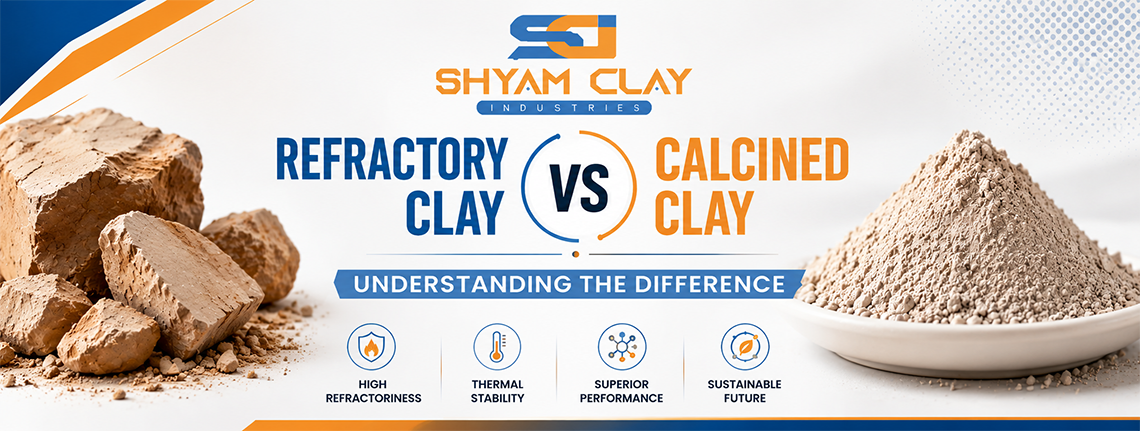
Refractory Clay vs Calcined Clay
There is no question that the selection of suitable clay in the industrial process has to be made with utmost care. There are two kinds of clays which are commonly used for different purposes and they are Refractory Clay and Calcined Clay. Although both are derived from clay minerals, there are some significant differences among them.
Many industries depend on a reputable Refractory Clay Supplier India or High Alumina Refractory Clay Manufacturer India in order to obtain their requirements. Let's discuss some basic details on Refractory Clay in the following passage:
What is Refractory Clay?
Refractory Clay or Fire Clay is a type of natural clay mineral with high contents of alumina and silica. Refractory Clay is highly appreciated for its unique resistance to high temperature.
Key Features:
- High heat resistance (above 1500°C)
- Excellent thermal shock resistance
- Strong mechanical strength
- High durability in extreme environments
Refractory clay is widely used in furnaces, kilns, and other high-temperature industrial processes. Many industries source it from a reliable Refractory Clay manufacturer in India for consistent performance.
Definition of Calcined Clay
Calcined Clay is defined as a type of clay that can be made by calcining clay in highly controlled environmental conditions at very high temperatures. The moisture present in the clay along with other volatile substances and organic material can be removed from it.
Important Characteristics:
- Lower shrinkage and moisture levels
- Greater brightness and whiteness
- Chemical stability
- Fine and consistent particle size
Calcined clay is generally employed in paints, coatings, plastics, and building materials instead of any high-temperature process.
Differences between Refractory Clay and Calcined Clay
Here are some important differences that will assist you in choosing the appropriate product for yourself.
1. Processing
- Refractory Clay : Employed in its natural state
- Calcined Clay : Heat-treated to improve its properties
2. Heat Resistance
- Refractory Clay : Can withstand high temperatures (over 1500°C)
- Calcined Clay : Unsuitable for extreme temperatures structurally
3. Uses
- Refractory Clay : Steel plants, cement plants, furnaces
- Calcined Clay : Coatings, paints, plastics, rubbers
4. Structural Integrity
- Refractory Clay : Maintains strength even in high temperature and pressure
- Calcined Clay : Has good properties but is not designed for bearing loads under extreme temperature
5. Moisture
- Refractory Clay : Naturally moist
- Calcined Clay : Free of moisture due to heat-treatment
Use of High Alumina Refractory Clay
High Alumina Refractory Clay refers to a special kind of refractory clay with high content of alumina.
Advantages:
- Higher temperature resistance
- Better load-bearing capacity
- Increased resistance to chemical attack
Industries with demanding applications often prefer sourcing from a trusted High Alumina Refractory Clay manufacturer in India for superior performance.
When to Choose Refractory Clay vs Calcined Clay
Choose Refractory Clay if:
- Your application involves high temperatures
- You need thermal shock resistance
- You require structural strength in furnaces or kilns
Choose Calcined Clay if:
- You need a filler or additive
- Your application requires low moisture and high brightness
- You are working in paints, coatings, or construction
Why Choosing the Right Manufacturer Matters
The performance of both materials depends heavily on quality. Partnering with an experienced supplier ensures:
- Consistent material properties
- Reliable supply chain
- Advanced processing and quality control
- Customization as per industry needs
Working with a trusted Refractory Clay manufacturer in India ensures optimal performance in critical applications.
Why Choose Shyam Clay?
At Shyam Clay (shyamclay.com), we provide high-quality refractory and clay-based solutions tailored for industrial applications.
We are recognized as a reliable:
- Refractory Clay manufacturer in India
- High Alumina Refractory Clay manufacturer in India
Our Strengths:
- Premium raw material sourcing
- Advanced processing techniques
- Strict quality control
- Consistent domestic and export supply
Conclusion
There are several important differences between Refractory Clay and Calcined Clay, both of which have separate uses in various industries. Where refractory clay is best suited to withstand high temperatures, Calcined clay is best used as fillers and industrial additives.
It is imperative to select the services of an experienced and reputable High Alumina Refractory Clay manufacturer in India for all industrial purposes.